Tuesday, July 10, 2018

Creatives Teaching Creativity


In the books and articles I have been reading and researching on Students as Designers a pattern has emerged.  In today’s world creative thinking and problem solving are a capital all leading countries are striving to obtain to create the next economic breakthrough.  The ability to think and create new ideas from existing patters occurs through multiple disciplines and be possessed for the survival in the future.  In the article Creatives Teaching Creativity the authors discuss how it is expected for teachers of creative disciplines such as the arts to teach and foster creativity skills it is not clear students are learning it.
I believe students need to be creating every opportunity the can.  Students need to be designing and problem solving through authentic problems.  The article Creatives Teaching Creativity almost argues that Creatives (people in creative fields) have a monopoly the ability to teach creativity.  I disagree.  I believe that creativity in certain disciplines can be fostered easier because of the abstract nature of the discipline but all teachers can teach students to design, to create, and problem solve.  The hurdles of being a teacher makes teachers creative and makes them problem solvers.  Teaching creativity and problem solving just needs to be practiced.  Teaching creativity can be messy and chaotic in world where  time is strictly regulated and test taking strategies rule supreme.   

Students as Designers


The DDLS definition for Students as Designers:  Good learning designs engage students in using content to construct meaningful outcomes by comprehensively scaffolding students’ ability to design. I believe  Bruce Nussbaum would wholeheartedly support this definition and the concept of Students as Designers.  Bruce uses the example of Apple’s success to success to prove the point that fruitful enterprises are no longer based on energy extraction, manufacturing, or technology.  To gain success like Apple one must design with originality and use creative processes. 

Bruce believes promoting creative skills in the classroom will directly affects entrepreneurial ventures in the business world.  Creative designers who can frame new patters and use their knowledge to create new products and ideas are worth the most in the marketplace. Creativity is not rare, given to the few.  Creativity is in all.  It is a skill that can be nurtured, grown, and improved.  

Because the problems of the 21st century require more than one solution answers, the people who have developed deep creative skills will be the ones to solve these problems.
Good lesson design incorporates multi - literacies and promotes students ability to design in an authentic situation.  These lessons should teach students proper design techniques like CRAP and the encoding process (DEAPR) while being connected to the PICKLE.

Thursday, June 28, 2018

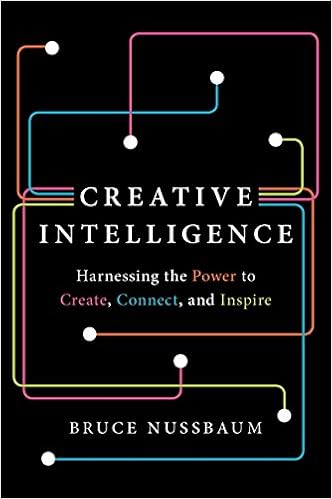
Creative Intelligence: Harnessing the Power to Create, Connect, and Inspire

Image result for creative intelligence

Bruce Nussbaum is a professor of innovation and design at Parsons School of design.  Among many other things, Bruce is an award-winning writer and former assistant managing editor for Business Week.  He is an expert in innovation and creativity.   In his book he coins the phrase creative intelligence (CQ) which he describes as a cultural literacy.  CQ is what is needed to solve problems in the modern, rapid changing, world that traditional methods have failed.  

Bruce shines a light on creativity and how it occurs.  He states that the brain functions in a distinct state when a person is creating.  Some have said the zone they are in while creating is "like leaving the planet".  Creativity is not just right-brained it is whole brained.  Creativity is something that can be cultivated and it is social.  He breaks down creativity into 5 competencies: Knowledge Mining – connecting information from various sources in new ways. Framing – Seeing the world through different lenses and adapting from points of view. Playing – The social structure of play.  Environments where failure and risk taking are promoted and where winning occurs. Making – Creating something or the “doing” part of creativity.  Pivoting – Moving from an idea to actual production.  The five competencies build a foundation for a new kind of economic system he calls Indie Capitalism.

In this book Bruce argues that creativity needs to be recognized as a skill that benefits the economy and there should be policy that promotes it in schools. Analytical abilities used to be what CEO's looked for in employees.  Now those skills must be accompanied by creative skills to be successful.  He says creativity is something that should be fluid and done every day.  Asian counties a studding creativity, promoting it in schools, and practicing it to boost industry.  We are not.

I though this book made really good points and I found many parallels form this book to Daniel Pink’s A Whole New Mind. The industrialization of education with the emphasis of standardized testing is killing creativity.  Creativity is hard to measure but is an extremely important literacy that isn’t being recognized in schools.  Business leaders understand this so should educators.   


Tuesday, June 26, 2018

Blog Introduction


I am currently an elementary music teaches that teaches grades Pre K - 4th.  I just finished my 8th year of teaching elementary music in the public school system.  I am a career switcher from The Sunshine State (FL) where I was a freelance musician and studio guitar teacher.  My musical background is in classical guitar performance.  When I’m not teaching music to the little ones I’m spending time with my little one who turned 2 in April.  I enjoy almost any outdoor activity but prefer the backcountry.  I love mountain biking, a good single malt, and fine cigars.

In this blog I will be reflecting and discussing community participation.  I will attempt to define community and blog about the different types of communities and how technology affects them.   According to wiki, A community is a small or large social unit (a group of living things) who have something in common, such as norms, religion, values, or identity.  I think community is much more than this and I will use this blog as a space to explain why.


Creatives Teaching Creativity

In the books and articles I have been reading and researching on Students as Designers a pattern has emerged.   In today’s world creative...